
Planetary Geoscientist

Ari J. Guest

PhD Studentthey/she

University of PortsmouthTREES DLA2025-present

Planetary scientist researching impact melt sheets and early crustal evolution.

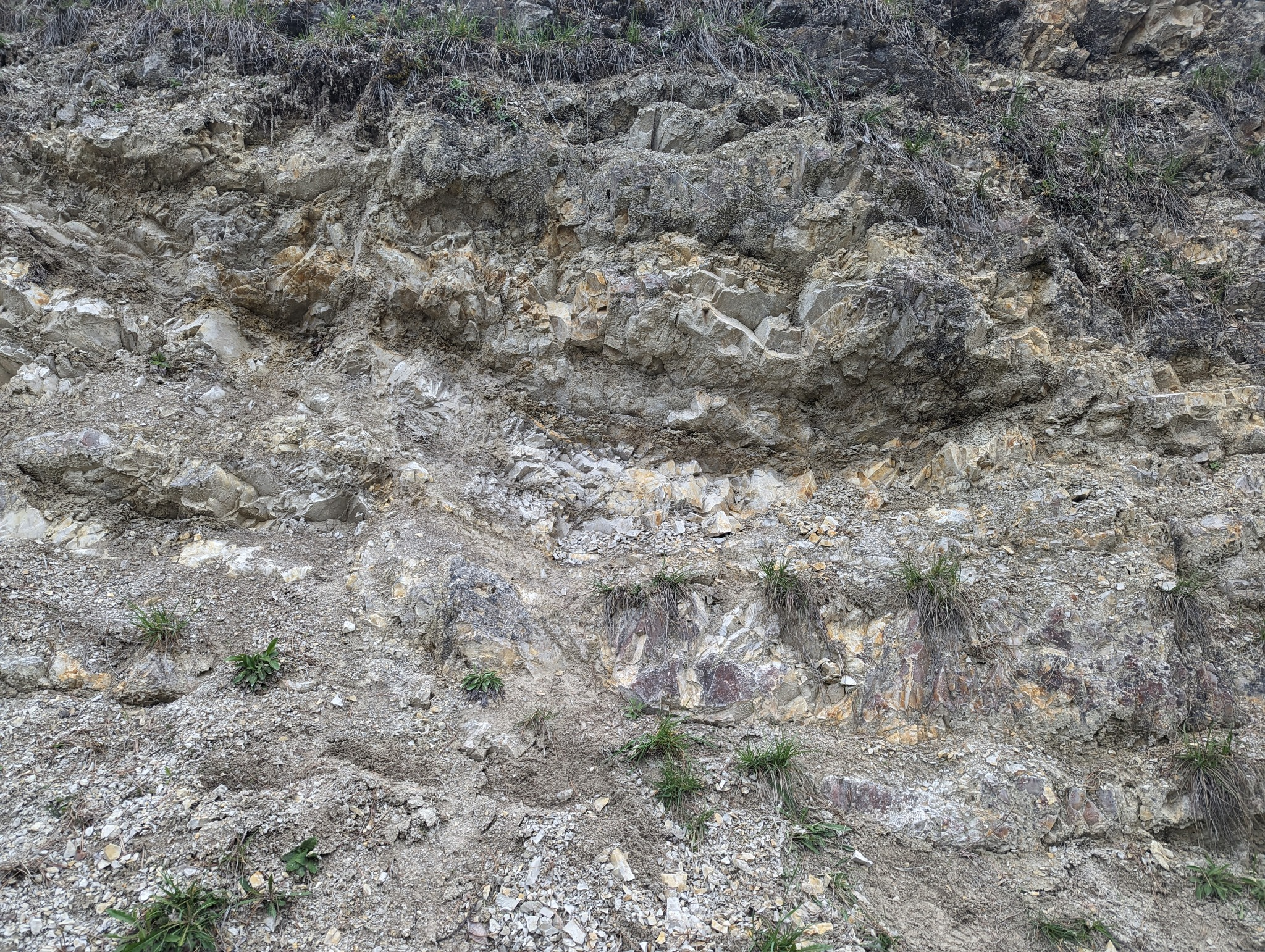
Ari J. Guest beside a shatter-coned rock outcrop at the Sudbury impact structure
Sudbury Impact Structure, Ontario.Ari with shatter cones exposed in the background.

How do impact melt sheets differentiate?

Test how crystallisation, assimilation and roof interaction generate the Sudbury Igneous Complex.

At Sudbury, I test whether differentiation of a single crustal impact melt can generate the norite-quartz gabbro-granophyre sequence and the discontinuous melanorite bodies. The central question is whether melanorite and the Upper Contact Unit preserve a rapidly cooled roof sequence, including blocks that later foundered into the melt sheet, or instead record assimilation, immiscibility or separate emplacement. Field relationships, petrography, mineral chemistry and whole-rock geochemistry are compared across roof-proximal and internal occurrences, then tested against phase-equilibrium models. A roof origin is supported only if spatial, textural and compositional evidence converge.
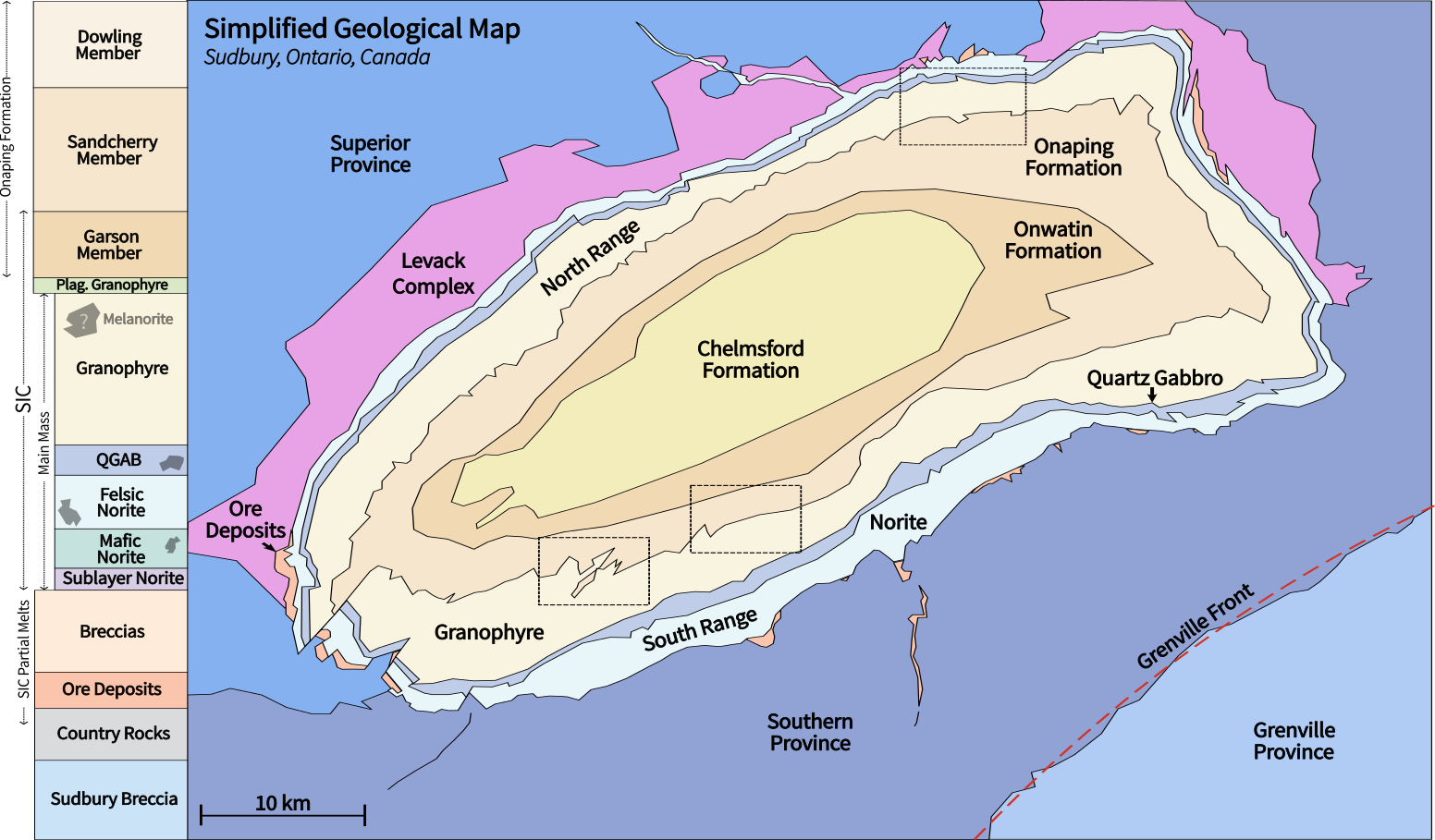
(Anders et al., 2015; Latypov et al., 2019)

What thermal history survives in minerals?

Resolve shock, melting, crystallisation, cooling and alteration from mineral chemistry and microstructure.

Optical petrography, SEM imaging and chemistry, EBSD and U-Pb analysis are combined so isotopic ages remain tied to specific mineral domains. In baddeleyite, EBSD can distinguish deformation, recrystallisation and orientation relationships inherited from high-temperature ZrO2, providing thermal constraints that are interpreted alongside, rather than as, crystallisation ages. Lower-temperature crystallisation is tested independently with phase equilibria and plagioclase-saturated melt models. These approaches separate shock, melting, crystallisation, cooling and later alteration without treating any single signal as uniquely diagnostic.

(White et al., 2018; Cutler et al., 2024; Horstwood et al., 2016)

Can giant impacts build planetary crust?

Compare Sudbury, Apollo Mg-suite rocks and lunar meteorites to test impact-driven crustal formation and reworking.

Apollo Mg-suite rocks and lunar meteorites provide a less reworked test of whether basin-scale impact melt sheets contributed to early crustal construction. Cumulate textures establish crystallisation sequence, baddeleyite orientation relationships test for high-temperature ZrO2 phase heritage, and microstructure-led U-Pb data separate crystallisation from later shock or thermal resetting. Sudbury provides the mapped, kilometre-scale analogue. The impact-melt hypothesis is evaluated against intrusive, magma-ocean and metamorphic alternatives using evidence that must agree across mineralogy, crystallography, geochronology and thermodynamic modelling.

(White et al., 2020; Latypov et al., 2019)

Scanning Electron Microscopy

SE and BSE imaging, EDS mapping, WDS mineral chemistry, and EBSD crystallography, microstructure and phase heritage.

Correlative electron-beam analysis links texture, chemistry and crystallography within the same mineral domain. BSE imaging and EDS mapping locate mineral phases, zoning, reaction textures, alteration and Zr-bearing accessories. Quantitative WDS resolves the mineral chemistry needed to compare melanorite, Upper Contact Unit and Main Mass assemblages and to constrain modelling. EBSD maps phase, lattice orientation, internal misorientation, recrystallisation and baddeleyite phase heritage. Together, these datasets identify which domains preserve primary crystallisation, shock modification or later alteration before isotopic analysis.

(Prior et al., 1999; White et al., 2018)

Raman

Mineral and structural identification.

Micro-Raman spectroscopy provides non-destructive mineral and structural identification from vibrational spectra. It is used to test phase assignments, distinguish polymorphs and screen shock-affected or altered domains that are ambiguous in imaging or EDS alone. Interpretations are cross-checked against petrography, chemistry and EBSD because fluorescence, mixed phases, orientation and structural disorder can complicate individual spectra.

LA-ICP-MS

Trace elements and U-Pb geochronology.

LA-ICP-MS provides spatially resolved trace-element and U-Pb measurements from accessory minerals. Targets are selected from petrography, BSE, cathodoluminescence and EBSD so analyses avoid cracks, mixed phases and altered domains. Reference materials monitor accuracy and fractionation, while common Pb, discordance and analytical uncertainties are carried through interpretation. Ages are accepted as geological only when their isotopic behaviour is consistent with the mapped microstructure, allowing crystallisation to be separated from impact-related disturbance or later resetting.

(Horstwood et al., 2016)

Thermodynamic Modelling

Phase equilibria and magmatic evolution.

THERMOCALC models the stable assemblages and mineral compositions expected from candidate Sudbury melt compositions across pressure-temperature space. Onaping impact glasses provide provisional starting compositions, while bulk composition, assimilation and thermal conditions are varied explicitly. Predictions are tested against measured melanorite, Upper Contact Unit and Main Mass assemblages rather than used in isolation. Plagioclase-saturated melt thermometry and hygrometry provide an independent lower-temperature check, restricted to plagioclase-saturated compositions within the published 664-1355 °C calibration range.

(Holland & Powell, 2011; Cutler et al., 2024)

Field Mapping

Contacts, lithologies and structural context.

Field mapping records contacts, lithological transitions, inclusions, grain-size changes, alteration and structural position across roof-proximal melanorite, the Upper Contact Unit, internal melanorite bodies and comparable Main Mass rocks. Samples remain tied to their mapped stratigraphic context throughout petrographic, geochemical and isotopic analysis. This prevents compositional similarity alone from being treated as proof of common origin and allows roof crystallisation, foundering, assimilation and separate emplacement models to be tested against their predicted field relationships.

(Anders et al., 2015; Latypov et al., 2019)

PhD Student

University of Portsmouth · TREES DLA

Igneous processes in impact melt sheets, Apollo Mg-suite materials, lunar meteorites and lithosphere evolution.

Rover Science Operations

Mars Yard field simulation

LIBS operations and geological decisions during a six-day analogue mission.

MEarthSci

University of Manchester

Shatter-cone microanalysis, shock mineralogy and U-Pb geochronology at Steinheim and Santa Fe.

Undergraduate

University of Manchester · Lake District

Point-bar morphodynamics and heavy-mineral concentration at Coledale Beck.

NERCFunding Provider via TREES
2025

TREES Doctoral Studentship

~£200k covering stipend, fees, research and training support.

2023-24

Departmental Awards

Two University of Manchester departmental awards.

2023

Stellify Award

Leadership, volunteering and ethical grand challenges.

Stargazing · University of Portsmouth · 28 January 2026Meteorites and Their FormationAll-age public engagement on meteorite types, their origins and formation.
Meteorite classification guide comparing undifferentiated chondrites with differentiated achondrites, stony-irons and iron meteorites
  1. Anders, D., Osinski, G. R., Grieve, R. A. F., & Brillinger, D. T. M. (2015). The Basal Onaping Intrusion in the North Range: Roof rocks of the Sudbury Igneous Complex. Meteoritics & Planetary Science, 50(9), 1577-1594. https://doi.org/10.1111/maps.12497
  2. Cutler, K. S., Cassidy, M., & Blundy, J. D. (2024). Plagioclase-saturated melt hygrothermobarometry and plagioclase-melt equilibria using machine learning. Geochemistry, Geophysics, Geosystems, 25, e2023GC011357. https://doi.org/10.1029/2023GC011357
  3. Holland, T. J. B., & Powell, R. (2011). An improved and extended internally consistent thermodynamic dataset for phases of petrological interest, involving a new equation of state for solids. Journal of Metamorphic Geology, 29(3), 333-383. https://doi.org/10.1111/j.1525-1314.2010.00923.x
  4. Horstwood, M. S. A., Košler, J., Gehrels, G., Jackson, S. E., McLean, N. M., Paton, C., Pearson, N. J., Sircombe, K., Sylvester, P., Vermeesch, P., Bowring, J. F., Condon, D. J., & Schoene, B. (2016). Community-derived standards for LA-ICP-MS U-(Th-)Pb geochronology: Uncertainty propagation, age interpretation and data reporting. Geostandards and Geoanalytical Research, 40(3), 311-332. https://doi.org/10.1111/j.1751-908X.2016.00379.x
  5. Latypov, R., Chistyakova, S., Grieve, R., & Huhma, H. (2019). Evidence for igneous differentiation in Sudbury Igneous Complex and impact-driven evolution of terrestrial planet proto-crusts. Nature Communications, 10, 508. https://doi.org/10.1038/s41467-019-08467-9
  6. Prior, D. J., Boyle, A. P., Brenker, F., Cheadle, M. C., Day, A., Lopez, G., Peruzzo, L., Potts, G. J., Reddy, S., Spiess, R., Timms, N. E., Trimby, P., Wheeler, J., & Zetterström, L. (1999). The application of electron backscatter diffraction and orientation contrast imaging in the SEM to textural problems in rocks. American Mineralogist, 84(11-12), 1741-1759. https://doi.org/10.2138/am-1999-11-1204
  7. White, L. F., Darling, J. R., Moser, D. E., Cayron, C., Barker, I. R., Dunlop, J., & Tait, K. T. (2018). Baddeleyite as a widespread and sensitive indicator of meteorite bombardment in planetary crusts. Geology, 46(8), 719-722. https://doi.org/10.1130/G45008.1
  8. White, L. F., Černok, A., Darling, J. R., Whitehouse, M. J., Joy, K. H., Cayron, C., Dunlop, J., Tait, K. T., & Anand, M. (2020). Evidence of extensive lunar crust formation in impact melt sheets 4,330 Myr ago. Nature Astronomy, 4, 974-978. https://doi.org/10.1038/s41550-020-1092-5